
If you are a Civil Engineering graduate looking for a job in Dubai, here is a new opportunity that may be worth checking. A confidential employer in Dubai is hiring for the position of Civil Engineer.
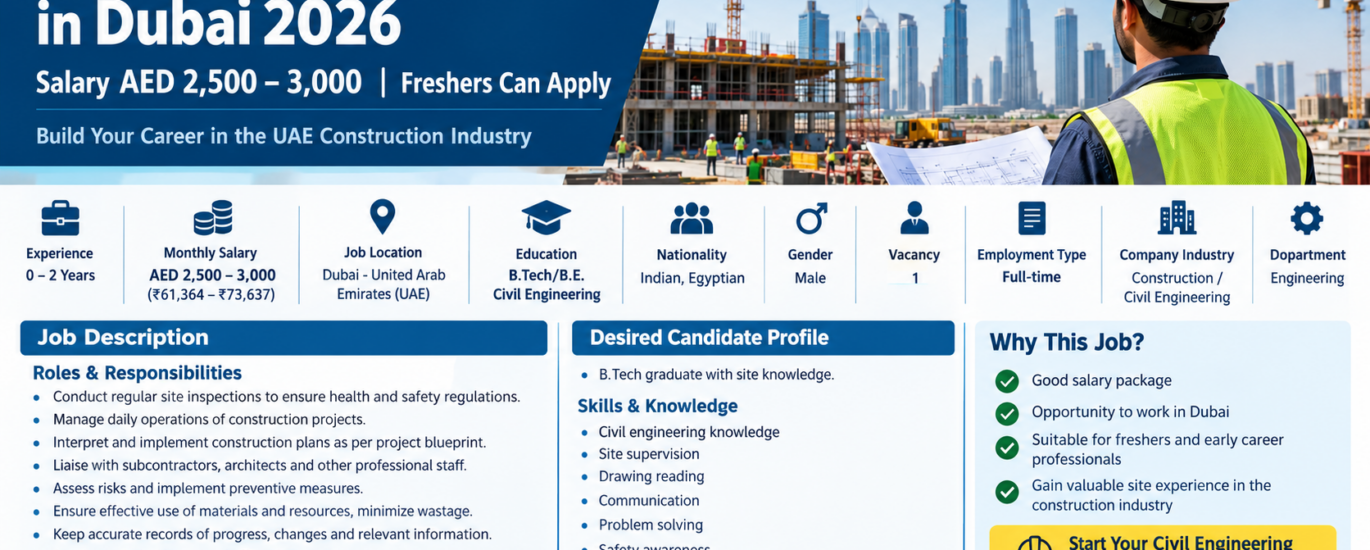
According to the available job details, the company is looking for a male Civil Engineer with a Bachelor of Technology or Bachelor of Engineering degree in Civil Engineering. Candidates with 0 to 2 years of experience can apply, which means the position may also be suitable for fresh Civil Engineering graduates who have good site knowledge.
The job is based in Dubai, United Arab Emirates, and the salary mentioned in the listing is AED 2,500 to AED 3,000 per month. The listing also shows one vacancy, and both Indian and Egyptian candidates are eligible according to the provided information.
This is a full-time construction and civil engineering job, where the selected candidate will mainly be involved in construction site operations, inspections, coordination, supervision, safety, materials, project progress, and technical issues.
In this article, we will explain the job details, responsibilities, eligibility, required skills, salary, experience, daily work, and other important points in simple English.
Civil Engineer Job Details
Here is a quick overview of the vacancy:
| Job Detail | Information |
|---|---|
| Job Title | Civil Engineer |
| Company | Confidential Employer |
| Location | Dubai, UAE |
| Experience | 0–2 Years |
| Salary | AED 2,500–3,000 per month |
| Education | Bachelor of Technology/Engineering in Civil |
| Nationality | Indian, Egyptian |
| Gender | Male |
| Vacancy | 1 |
| Employment Type | Full-time |
| Industry | Construction / Civil Engineering |
| Department | Engineering |
The job is suitable for candidates who have completed their Civil Engineering degree and have basic knowledge of construction site work.
Civil Engineer Job in Dubai
Civil Engineers play an important role in construction projects. They are involved in different stages of a project, starting from site activities and construction planning to quality, safety, coordination, and project completion.
For this particular position, the employer is looking for someone who can understand construction plans, manage daily site activities, coordinate with different people, supervise workers, and help solve technical problems.
The job listing specifically mentions site knowledge as part of the desired candidate profile.
This means candidates should have a basic understanding of what happens on a construction site and should be comfortable working around construction teams, subcontractors, materials, drawings, and project activities.
Salary for the Civil Engineer Job
The listed monthly salary for this position is:
AED 2,500 – AED 3,000 per month
The job listing gives a salary range of AED 2,500 to AED 3,000.
The exact salary offered to the selected candidate may depend on the employer’s hiring terms, experience, interview performance, and other factors.
Candidates should confirm the complete salary package and other benefits directly with the employer before accepting the job.
The listing provided does not give complete information about accommodation, transportation, food, medical insurance, annual leave, air tickets, or other benefits. Therefore, candidates should not assume that these benefits are included unless the employer confirms them.
Who Can Apply for This Job?
According to the provided job information, candidates from the following nationalities can apply:
- Indian
- Egyptian
The listed gender requirement is:
- Male
The experience requirement is 0 to 2 years.
This is important because the position does not ask for many years of experience. Candidates who are starting their Civil Engineering career may also consider this opportunity if they meet the other requirements.
Educational Qualification
The required education for this position is:
Bachelor of Technology or Bachelor of Engineering in Civil Engineering
Candidates should have a Civil Engineering degree from a recognized institution.
The job specifically mentions a B.Tech graduate with site knowledge as the desired candidate profile.
Therefore, having a Civil Engineering degree alone may not be enough. Candidates should also be able to understand basic construction site activities.
Is This Job Suitable for Freshers?
The experience requirement is 0 to 2 years, so the job can potentially be considered by fresh graduates as well as candidates with some early career experience.
However, candidates should pay attention to the phrase “with Site knowledge” in the job description.
A fresher who has completed an internship, site training, academic project, or practical training related to construction may be able to demonstrate this knowledge during the hiring process.
For example, candidates who have visited construction sites during their studies or worked as trainees can mention this experience in their CV.
What Does a Civil Engineer Do on a Construction Site?
A Civil Engineer working on a construction project has many responsibilities.
The engineer may have to monitor site activities, check whether work is being done according to the plans, coordinate with workers and subcontractors, inspect construction progress, and report problems to the project team.
The exact responsibilities can vary depending on the project and company.
For this particular vacancy, the employer has listed several responsibilities that the selected candidate will be expected to handle.
Let’s understand them one by one.
1. Conduct Regular Site Inspections
One of the main responsibilities is conducting regular site inspections.
A Civil Engineer needs to visit different areas of the construction site and check whether work is progressing properly.
During an inspection, the engineer may need to look at construction activities, safety conditions, materials, workmanship, and progress.
Regular inspections can help identify problems before they become bigger issues.
The engineer should also check whether workers are following the required safety procedures.
2. Follow Health and Safety Regulations
Construction sites can involve different risks, including heavy equipment, machinery, working at height, moving materials, electrical work, and other activities.
Because of this, health and safety are important parts of construction work.
The Civil Engineer will be expected to make sure that construction activities are being carried out according to the required safety rules.
If the engineer notices an unsafe activity or condition, it may need to be reported and corrected.
A good Civil Engineer should not ignore safety problems simply because the project needs to move quickly.
Safety should remain an important part of daily site management.
3. Manage Daily Construction Operations
Another important responsibility is managing the daily operations of construction projects.
This means the Civil Engineer may need to monitor what work is planned for the day and check whether the construction team is completing the planned activities.
Daily site operations can include:
- Checking ongoing construction work
- Supervising workers
- Coordinating with subcontractors
- Checking materials
- Monitoring progress
- Identifying site problems
- Communicating with project staff
- Following construction plans
- Maintaining site records
The engineer needs to keep track of different activities so that the project can continue smoothly.
4. Understand Construction Plans
A Civil Engineer must be able to understand construction drawings and project plans.
The job description specifically mentions interpreting and implementing construction plans according to the project blueprint.
This means the selected candidate should be comfortable reading construction drawings and understanding what needs to be built.
The engineer may need to compare the actual site work with the approved drawings and identify any differences.
If there is a technical issue or uncertainty in the drawing, the engineer may need to discuss it with the relevant project team.
5. Implement the Project Blueprint
Understanding a drawing is only one part of the job.
The engineer also needs to make sure that the construction team follows the project requirements.
This may involve explaining the planned work to supervisors, workers, or subcontractors and monitoring the actual construction.
The Civil Engineer should make sure that site work is carried out according to the approved project requirements.
6. Coordinate With Subcontractors
Construction projects often involve several subcontractors.
Different subcontractors may be responsible for different types of work.
The Civil Engineer may need to coordinate with them to make sure their work is completed properly and according to the project schedule.
Good coordination is important because delays or misunderstandings between different teams can affect the overall project.
The engineer may need to communicate work requirements, discuss problems, check progress, and follow up on pending activities.
7. Coordinate With Architects
The Civil Engineer may also need to communicate with architects and other professionals working on the project.
Construction projects usually involve different professionals, and their work needs to be coordinated.
For example, architectural requirements may need to be considered during civil construction.
The engineer needs to understand the project requirements and communicate with the relevant team whenever there is a technical or construction-related issue.
8. Work With Other Professional Staff
The job description also mentions working with other professional staff.
A construction project may include:
- Civil Engineers
- Architects
- Site Supervisors
- Project Managers
- Quantity Surveyors
- Safety professionals
- Electrical professionals
- Mechanical professionals
- Subcontractors
- Consultants
The Civil Engineer may have to communicate with several of these people during the project.
Good teamwork and communication are therefore important for this role.
9. Identify Project Risks
Another responsibility mentioned in the job listing is assessing potential risks.
Construction projects can face different types of risks.
For example, there may be:
- Safety risks
- Material problems
- Construction delays
- Technical issues
- Poor workmanship
- Equipment problems
- Weather-related issues
- Coordination problems
The Civil Engineer needs to identify possible problems and communicate them to the relevant project team.
10. Take Preventive Measures
Identifying a problem is only the first step.
The next step is to find a suitable way to prevent the problem from becoming more serious.
For example, if a site activity could create a safety risk, the engineer should communicate the issue and work with the responsible team to address it.
Similarly, if a construction activity is falling behind schedule, the engineer may need to discuss the issue with the project team and look for a practical solution.
11. Use Materials Properly
Construction materials are an important part of every project.
The job description says the Civil Engineer should make sure materials and resources are used effectively and that wastage is minimized.
This means the engineer needs to monitor how materials are being used on site.
Unnecessary material wastage can increase project costs and create other problems.
Proper planning and monitoring can help reduce waste.
12. Monitor Construction Materials
The engineer may need to keep an eye on the availability and use of construction materials.
If an important material is not available when needed, construction work may be delayed.
Therefore, site teams need to communicate their material requirements properly.
The Civil Engineer may coordinate with the relevant team to ensure that the required materials are available for planned work.
13. Maintain Construction Records
Record keeping is another important responsibility mentioned in the job description.
The engineer needs to keep accurate records of construction progress, changes, and other relevant information.
Construction records can include information about:
- Daily progress
- Completed work
- Site activities
- Changes
- Technical issues
- Material usage
- Inspections
- Delays
- Other project-related information
Accurate records can help the project team understand what has happened on site.
14. Track Project Progress
A Civil Engineer should know how much work has been completed and what work is still pending.
Monitoring project progress helps the team understand whether construction is moving according to the plan.
If the project is behind schedule, the issue can be discussed with the relevant people.
The engineer may need to report progress regularly to senior project staff.
15. Handle Technical Problems
Construction sites can face technical issues from time to time.
The job description requires the Civil Engineer to help resolve technical problems with the project team.
This does not necessarily mean that the engineer will solve every problem alone.
The engineer may need to understand the problem, collect relevant information, discuss it with senior engineers or other professionals, and help find a practical solution.
16. Suggest Improvements
The selected candidate may also be expected to provide advice on improvements and solutions.
If the engineer notices that a construction activity can be performed more efficiently or safely, they may communicate the suggestion to the project team.
Good site engineers should pay attention to what is happening around them and report problems instead of simply completing their daily tasks.
17. Coordinate With Clients
The job description also mentions coordination with clients.
Clients are an important part of construction projects because the project is being completed for them.
The Civil Engineer may need to communicate with clients or their representatives regarding site progress, technical matters, inspections, or other project-related issues.
Professional communication is important during these interactions.
18. Coordinate With Stakeholders
A construction project can have several stakeholders.
The Civil Engineer may need to coordinate with different people involved in the project.
This could include project management teams, clients, consultants, contractors, subcontractors, and other professionals.
Good coordination can help avoid misunderstandings and keep construction activities moving.
19. Coordinate With Local Authorities
The job description also mentions coordination with local authorities.
Depending on the project, construction activities may need to follow local rules, approvals, inspections, and requirements.
The engineer may need to communicate with the relevant authorities or support the project team in completing required processes.
The exact requirements will depend on the project.
20. Supervise the Construction Team
The selected Civil Engineer will also be responsible for supervising the construction team.
Supervision means monitoring whether workers are doing the assigned work properly and according to project requirements.
The engineer may need to explain work requirements, check progress, identify problems, and communicate instructions.
21. Instruct Site Laborers
The job listing specifically mentions supervising and instructing onsite laborers.
This means the engineer should be able to communicate clearly with workers.
Instructions should be practical and easy to understand.
The engineer should also monitor whether the work is being completed correctly.
Site Knowledge Is Important for This Job
The desired candidate profile specifically mentions:
B.Tech graduate with Site knowledge
This is an important point for applicants.
A Civil Engineering graduate should understand basic construction activities and should be comfortable working at a construction site.
Candidates who have completed site internships or training should mention them in their CV.
What Does “Site Knowledge” Mean?
Site knowledge generally means understanding how construction work is actually carried out on the ground.
A candidate with site knowledge may understand basic concepts such as:
- Site inspection
- Construction drawings
- Concrete work
- Reinforcement work
- Excavation
- Masonry
- Formwork
- Measurements
- Materials
- Safety procedures
- Construction sequence
- Site supervision
The exact knowledge required depends on the project.
Skills That Can Help a Civil Engineer
For this job, candidates should focus on both technical and practical skills.
Some useful skills include:
Civil Engineering Knowledge
A strong understanding of basic Civil Engineering concepts is important.
Site Supervision
The candidate should be comfortable monitoring construction work.
Drawing Reading
Understanding construction drawings is important for site work.
Communication
The engineer will communicate with workers, subcontractors, architects, clients, and other professionals.
Problem Solving
Construction sites can have unexpected problems, so practical problem-solving ability is useful.
Safety Awareness
Understanding construction safety is important.
Teamwork
Construction projects require people from different areas to work together.
Record Keeping
The engineer should be able to maintain accurate project records.
Why Communication Skills Matter
A Civil Engineer does not work alone.
On a typical construction project, the engineer may communicate with workers in the morning, subcontractors during the day, architects or project managers about technical issues, and clients or other stakeholders when required.
Because of this, communication is an important part of the job.
The engineer should be able to explain work clearly and listen carefully when someone reports a problem.
Why Safety Knowledge Matters
Safety is one of the most important parts of construction work.
A Civil Engineer working on site should understand basic safety practices and should be able to identify unsafe conditions.
The job description specifically mentions site inspections and health and safety regulations.
Candidates should therefore be prepared to discuss their understanding of construction safety during the interview.
How Freshers Can Prepare for This Job
Candidates with little or no professional experience can focus on their academic and practical knowledge.
If you have completed a Civil Engineering degree recently, review the major subjects you studied.
You should also revise practical construction topics and understand how common site activities are performed.
If you completed an internship, include it in your CV.
Even a short site internship can help demonstrate that you have some practical exposure.
What Should Be Included in the CV?
For this Civil Engineer position, candidates should create a clear and simple CV.
The CV can include:
- Full name
- Contact details
- Professional summary
- Civil Engineering degree
- Internship experience
- Work experience
- Site experience
- Technical skills
- Software knowledge
- Certifications
- Relevant projects
Do not add skills that you do not actually have.
Highlight Your Site Experience
If you have worked on a construction site before, make this information easy to find in your CV.
Mention the type of project and your responsibilities.
For example, if you worked on site inspections, measurements, material checking, drawing interpretation, or worker supervision, mention these activities clearly.
This can make your profile more relevant to the job.
Interview Preparation for Civil Engineer Job
Before attending the interview, candidates should prepare for both technical and practical questions.
The interviewer may want to know whether you understand construction work and whether you can handle responsibilities on a site.
You should be prepared to explain your education, previous experience, internship, site knowledge, and technical skills.
Possible Interview Questions
Here are some questions a Civil Engineer candidate may be asked:
Tell us about yourself.
Keep your answer short and focus on your Civil Engineering education and relevant experience.
What experience do you have on construction sites?
Talk about your previous job, internship, training, or project experience.
Can you read construction drawings?
Be honest about your level of knowledge and explain what types of drawings you have worked with.
How do you conduct a site inspection?
Explain that you would check the ongoing work, safety conditions, quality, progress, and compliance with project requirements.
How do you handle a technical problem?
Explain that you would understand the issue, collect the necessary information, discuss it with the relevant team, and follow the appropriate solution.
How do you reduce material wastage?
Talk about proper planning, monitoring material usage, correct storage, and avoiding unnecessary waste.
How do you manage workers on site?
Explain how you would communicate work instructions clearly, monitor progress, and maintain safety and discipline.
How to Answer Interview Questions
Do not try to give very complicated answers.
A simple and clear answer is usually easier to understand.
If you have actual experience, give a small example.
For example, instead of saying:
“I possess excellent site management capabilities.”
You can explain what you actually did:
“I worked with the site team, checked daily construction activities, followed the drawings, and reported issues to my senior engineer.”
Specific examples can make your answer clearer.
Do Not Claim Experience You Don’t Have
This is especially important for candidates with 0 to 2 years of experience.
If you are a fresher, do not claim that you managed a large construction project if you did not.
Instead, talk about your education, internship, training, academic projects, and site exposure.
Honest information is better than adding false experience to your CV.
Dubai Civil Engineer Job for Early Career Candidates
The 0–2 year experience range makes this vacancy relevant to candidates who are at the beginning of their Civil Engineering careers.
For a young Civil Engineer, site experience can be an important part of professional development.
Working on construction projects can help candidates understand how engineering concepts are applied in real situations.
However, candidates should carefully review the actual job conditions before accepting an offer.
What Can a Civil Engineer Learn From Site Work?
Site work can provide practical exposure to many areas of construction.
A Civil Engineer can learn how drawings are converted into actual construction, how teams coordinate, how materials are managed, and how site problems are handled.
The engineer can also learn how safety, quality, time, and resources are managed together.
This practical experience can be valuable for building a long-term career in construction.
Working With Subcontractors
Subcontractors are commonly involved in construction projects.
The Civil Engineer may need to coordinate with them regarding work schedules, technical requirements, site access, materials, and progress.
The engineer should make sure that communication is clear and that any issues are reported to the relevant project team.
Working With Architects
Architectural drawings and civil construction work need to match the project requirements.
The Civil Engineer may communicate with architects when there are questions about drawings, dimensions, design details, or site conditions.
Good coordination can help reduce confusion during construction.
Working With Clients and Stakeholders
Client communication requires professionalism.
The engineer should provide accurate information about project progress and should avoid making promises without confirmation from the appropriate project team.
If there is a technical issue, it should be communicated clearly and handled through the proper process.
Managing Construction Resources
Construction projects use many different resources.
These can include:
- Materials
- Labor
- Equipment
- Time
- Money
The Civil Engineer may help ensure that these resources are being used properly.
Good resource management can help reduce unnecessary wastage and delays.
Why Record Keeping Is Important
Construction records provide a history of what happened during a project.
For example, if there is a disagreement about when a particular activity was completed, proper records can help the project team understand the situation.
Records can also help track changes, progress, inspections, and other important project information.
Therefore, record keeping should not be treated as an unnecessary task.
Managing Daily Construction Work
Daily construction management requires planning and follow-up.
At the beginning of the day, the engineer may need to understand the planned activities.
During the day, progress should be monitored.
At the end of the day, completed work and pending issues may need to be recorded.
The exact process depends on the company and project.
Handling Delays
Construction projects can sometimes experience delays.
A delay may happen because of material shortages, manpower problems, equipment issues, technical problems, weather, approvals, or coordination issues.
The Civil Engineer should identify the reason for the delay and communicate it to the relevant team.
The goal is to help the project team find a practical way forward.
Importance of Teamwork
A construction project cannot be completed by one person.
Engineers, workers, supervisors, subcontractors, architects, consultants, clients, and other professionals may all be involved.
A Civil Engineer needs to work well with different people.
Respectful communication and proper coordination can make daily site work easier.
Full-Time Employment
The listing states that this is a full-time position.
Candidates should therefore be prepared for regular employment and daily construction-related responsibilities.
Since the job is site-based in nature, candidates should understand that the work may involve spending significant time at a construction site.
The exact working hours and weekly schedule should be confirmed with the employer.
Construction Industry Experience
The company industry mentioned in the listing is:
Construction / Civil Engineering
Therefore, candidates interested in construction projects and site engineering may find the role relevant to their career goals.
Candidates should understand that construction work can be demanding and requires attention to safety, quality, deadlines, and coordination.
What Makes This Role Different From an Office-Based Engineering Job?
A site-based Civil Engineer spends more time dealing with actual construction activities.
Instead of only preparing documents or working on designs, the engineer may need to monitor physical work, supervise workers, inspect construction, coordinate with subcontractors, and solve site problems.
This can provide practical experience that is different from a purely office-based engineering position.
What Should You Ask the Employer?
Before accepting the job, candidates should ask the employer about important details that are not included in the listing.
These may include:
- Exact working hours
- Weekly working days
- Overtime policy
- Accommodation
- Transportation
- Medical insurance
- Annual leave
- Air ticket policy
- Visa arrangements
- Probation period
- Contract duration
- Exact work location
- Joining date
- Other employment benefits
Getting these details in writing can help avoid confusion later.
Important Note About Salary
The advertised salary is AED 2,500–3,000 per month.
However, the listing does not provide a full breakdown of the employment package.
Candidates should therefore confirm whether the stated amount is the basic salary or the complete monthly salary package.
They should also ask about any additional benefits before accepting the offer.
Is Dubai Experience Required?
The provided listing does not specifically say that previous UAE experience is required.
The experience range is 0–2 years.
This means candidates with limited experience may be considered, subject to the employer’s selection process and other requirements.
Candidates should focus on demonstrating their Civil Engineering education and practical site knowledge.
Is a Master’s Degree Required?
No Master’s degree is mentioned in the provided job listing.
The required education is a Bachelor of Technology/Engineering in Civil.
Therefore, candidates should focus on meeting the listed Bachelor’s degree requirement.
Is Civil Engineering Degree Mandatory?
The listing specifically asks for a Bachelor of Technology/Engineering in Civil.
Therefore, candidates from unrelated educational backgrounds should carefully check with the employer before applying.
A Civil Engineering degree is directly connected to the responsibilities mentioned in the job description.
Why Site Knowledge Is Important for Fresh Graduates
Civil Engineering education provides theoretical knowledge, but construction sites involve real-world situations.
A fresher may know the theory but still need practical experience to understand how construction work happens in real life.
That is why site visits, internships, training, and practical projects can be useful.
Candidates should mention any relevant site exposure in their CV.
How to Make Your CV More Relevant
A Civil Engineer applying for this position should avoid sending a generic CV if possible.
Instead, highlight the areas that match the job description.
For example:
Civil Engineering Graduate
Site Inspection
Construction Supervision
Drawing Interpretation
Material Management
Safety Awareness
Subcontractor Coordination
Technical Problem Solving
Only include these skills if you genuinely have the required knowledge or experience.
A Simple CV Summary Example
A candidate could use a simple professional summary such as:
Civil Engineering graduate with practical knowledge of construction site activities, site supervision, construction drawings, safety procedures, material management, and project coordination. Looking for an opportunity to build a career in civil construction and contribute to site operations.
The candidate should adjust the summary according to their real experience.
What Should Freshers Mention?
Freshers can mention:
- Civil Engineering degree
- Internship
- Industrial training
- Academic projects
- Site visits
- Technical skills
- Construction-related software
- Relevant certifications
- Practical training
Do not worry if you do not have years of experience. The listed experience requirement is 0–2 years.
What Should Experienced Candidates Mention?
Candidates with one or two years of experience should clearly mention their previous responsibilities.
For example:
- Site supervision
- Daily progress monitoring
- Drawing interpretation
- Material checking
- Worker supervision
- Safety inspections
- Subcontractor coordination
- Client coordination
- Technical problem solving
This can make the CV more closely match the job requirements.
Final Overview of the Vacancy
This Civil Engineer vacancy in Dubai is for a full-time position with a confidential employer in the construction and Civil Engineering sector.
The company is looking for a male candidate with a Civil Engineering Bachelor’s degree and 0–2 years of experience.
The listed salary is AED 2,500 to AED 3,000 per month.
Indian and Egyptian candidates are mentioned as eligible nationalities.
The selected candidate will be involved in construction site activities, including site inspections, daily project operations, construction plan implementation, subcontractor coordination, risk assessment, material management, project records, technical problem solving, client coordination, stakeholder coordination, and supervision of construction workers.
The employer’s desired candidate profile is simple: a B.Tech graduate with site knowledge.
Final Conclusion
For Civil Engineering graduates looking for an early-career opportunity in Dubai, this vacancy offers a position focused on construction site work and project operations.
The job requires a Bachelor’s degree in Civil Engineering and accepts candidates with 0 to 2 years of experience. This makes it relevant to both fresh graduates and candidates who already have some early experience in construction.
The salary mentioned in the listing is AED 2,500 to AED 3,000 per month, and there is one vacancy.
The selected Civil Engineer will have several responsibilities. These include conducting regular site inspections, checking health and safety requirements, managing daily construction activities, understanding construction plans, coordinating with subcontractors and architects, assessing risks, managing materials, maintaining project records, solving technical issues, coordinating with clients and authorities, and supervising site workers.
One of the most important points in the listing is the requirement for site knowledge. Candidates should therefore be comfortable with basic construction activities and should understand how work is carried out on a real construction site.
Fresh Civil Engineering graduates can focus on their internship, practical training, academic projects, and site exposure when preparing their CV. Candidates with previous experience should clearly explain their construction and site responsibilities.
Before accepting the position, candidates should also confirm the complete employment package, including working hours, accommodation, transportation, medical coverage, visa arrangements, leave, overtime, and other benefits because these details are not provided in the job listing.
Overall, candidates interested in starting or continuing their career in Dubai’s construction and Civil Engineering sector can review this opportunity and check the employer’s official application process before applying.
Job Title: Civil Engineer
Location: Dubai, UAE
Experience: 0–2 Years
Salary: AED 2,500–3,000 per month
Education: B.Tech/B.E. Civil Engineering
Nationality: Indian, Egyptian
Gender: Male
Vacancy: 1
Job Type: Full-time